



























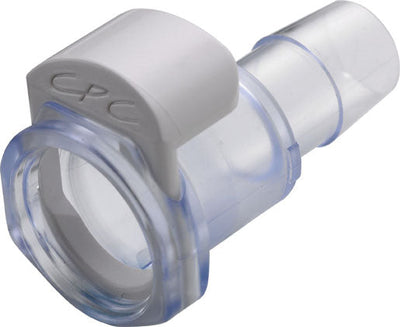
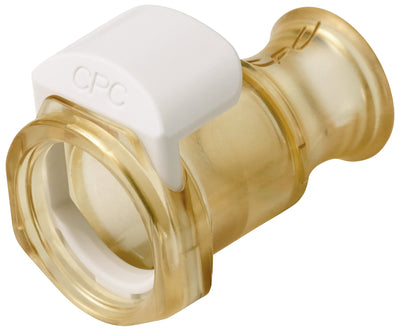
1/2” Hose Barb Class VI Polycarbonate Coupling Insert - High Temperature, AQC22008HT
ITEM # AQC22008HT-5
SaleManufactured by CPC®, AseptiQuik® C Connectors provide quick and easy sterile connections, even in non-sterile environments. AseptiQuik® C connectors’ “CLICK-PULL-TWIST” design enables users to transfer media easily with less risk of operator error. The connectors’ robust design provides reliable performance without the need for clamps, fixtures or tube welders. Biopharmaceutical manufacturers can make sterile connections with the quality and market availability they expect from the leader in single-use connection.
Every Product. Every Penny.
Risk-free with our 100% Money-Back Guarantee.
Always Free Expert Advice
Our Tech Team is happy to help!
Real People. No Robots.
Calls connect to a human within 9 seconds.
300K Customers Strong
Products used in 100 countries on 7 continents.
Pricing (Based on quantity)
- ✓ ○
Add to your cart to unlock
Use code at checkout — unlocked! No code unlocked yet — add more to reach and get
Pack Size
Net 30 terms available for qualified accounts — contact sales
Every Product. Every Penny.
Risk-free with our 100% Money-Back Guarantee.
Always Free Expert Advice
Our Tech Team is happy to help!
Real People. No Robots.
Calls connect to a human within 9 seconds.
300K Customers Strong
Products used in 100 countries on 7 continents.
Description
Manufactured by CPC®, AseptiQuik® C Connectors provide quick and easy sterile connections, even in non-sterile environments. AseptiQuik® C connectors’ “CLICK-PULL-TWIST” design enables users to transfer media easily with less risk of operator error. The connectors’ robust design provides reliable performance without the need for clamps, fixtures or tube welders. Biopharmaceutical manufacturers can make sterile connections with the quality and market availability they expect from the leader in single-use connection.
- CLICK-PULL-TWIST Design – Intuitive three-step connection process that reduces the risk of operator error.
- Membrane Pull Tabs – Enable simultaneous and secure removal of both membranes for a reliable sterile connection.
- Robust Construction – Delivers repeatable, dependable performance without the need for additional hardware.
- Integrated Lock Ring – Secures the final connection and prevents accidental disassembly.
- CPC Click Confirmation – Provides an audible “click” to confirm proper and complete assembly.
- Sterile media and buffer transfer in biopharmaceutical manufacturing
- Upstream bioprocess connections for bioreactors and seed trains
- Downstream processing integration for filtration and chromatography systems
- Cell and gene therapy fluid handling in closed systems
- Single-use sterile assemblies for secure aseptic connections
| Operating Conditions (Fluid Transfer) | |
| Pressure | 60 psi (4.1 bar) |
| Temperature | 39°F to 104°F (4°C to 40°C) |
| Typical Flow Rate | Cv ~14.4 max |
| Materials | |
| Connector | Polycarbonate (white), USP Class VI, ADCF |
| Lock Ring | Polycarbonate (blue), USP Class VI, ADCF |
| Pull Tabs | Polycarbonate (blue, standard version), USP Class VI, ADCF |
| Pull Tabs | Polycarbonate (white, HT version), USP Class VI, ADCF |
| Caps | Polypropylene (clear), USP Class VI, ADCF |
| Seals | Silicone (clear), platinum-cured, USP Class VI, ADCF |
| Membrane | Polyethylene (standard version), USP Class VI, ADCF |
| Membrane | Hydrophobic polyethersulfone (HT version), USP Class VI |
| Sterilization | |
| Gamma | Up to 50 kGy irradiation |
| Autoclave | High Temp (HT) Version: Up to 266°F (130°C) for 30 minutes |
| Other | |
| Termination Size | 1/2" ID hose barb (12.7 mm), 3/8" hose barb (9.5 mm) and 3/4" sanitary |
| Cv Value | |
| Cv ~14.4 max | |
| Cv values are based on gpm and psi, and Ipm and bar (shown in parentheses). | |
| WARNING: Pressure, temperature, chemicals and operating environment can affect the performance of couplings. It is the customer’s responsibility to test the suitability of Colder products in their own application conditions | |
Shipping & Returns
We ship within 1–2 business days. Returns accepted within 30 days of purchase.
Customers Also Bought


Frequently Bought Together
Lab safety professionals recommend pairing these items
Bundle Summary
items selectedPrice Breakdown
for items
Same warehouse — combine freight to save on shipping
Frequently Bought Together

This item
1/2” Hose Barb Class VI Polycarbonate...
for items
Same warehouse — combine freight to save on shipping
Frequently Asked Questions
General lab safety FAQs applicable to all categories and products.